News & Updates

Embedding Intelligence and Flexibility in Our Nation’s Electricity Grid

A white paper written by the Equilibrium Energy technical team, January 2026

Summary:

  • Last year, Equilibrium Energy unveiled PowerOS, a transformational enterprise AI and software platform built specifically for the power industry. 
  • The inspiration behind it was clear: the future of Power will be shaped by AI, but only if AI can understand the enterprise it’s operating in.
  • Achieving this outcome required a technical breakthrough: a way to close the context gap that prevents AI from effectively navigating the modern enterprise.
  • This white paper introduces Connective Intelligence™, our proprietary framework for closing the context gap by forming a unified landscape of data and business context.
  • The pages that follow explain its technical foundation and how it is unlocking new levels of value and speed of innovation for the power industry today.

A Glimpse into a Reimagined Future for Power

The early morning sun was rising in the Central Texas sky when the first reports came in. A blockbuster heat wave had been forecast to hit Texas over the next week, but the heat was already much stronger than expected. Then came the news: three 1.5 GW generators had unexpectedly gone offline at the exact moment demand was surging. The next week would see the grid and all the customers who rely on it pushed to their limits.

Across Texas and another two-thirds of the US,  power traders and their utility operator peers make power available to the grid at the right place and time. In a very real sense, they are the ones keeping the lights on. And every power trader in the region knew what was ahead: one of those weeks where every decision carried outsized consequences. Daily lives could be disrupted. Lives could be at risk. And their own businesses were on the line.

In the past, power trading teams would rise to weeks like this by descending into a blur of spreadsheets and rushing to adjust operations to best support the grid. They would race to reevaluate their portfolios, rapidly debate the implications of conflicting data and forecasts, sprint to reprice and rebid their physical and financial positions, and scramble to contemplate new information as events unfolded. In the face of incomplete data and fragmented systems, determination and instinct would have outsized influence on success or failure, for both the grid and their business.

On FuturePower’s trading floor, that chaos never materialized. Angela Krol, Head of Enterprise Portfolio Management, watched the heat wave unfold across an array of screens displaying real-time data from the entire Texas market and the company’s energy and financial portfolio. She could feel the weight of the moment, but the tension was gone. The events of the week would unfurl fast, yet her trading floor was calm and in control.

FuturePower’s new AI-enabled operating system had already absorbed the generator outages and grid reconfigurations, ingested disparate weather and market feeds, and run thousands of simulations to characterize all the likely outcomes. Within minutes, the system presented Angela with an integrated and co-optimized strategy: 

  • Congestion exposure adjustments that neutralized potential transmission constraints
  • Co-optimized generation bids to ensure availability during the most important moments of need
  • A dynamic energy hedging strategy to balance overall portfolio exposure 

This was more than black-box statistics. The AI understood the intricate relationships between physical assets, financial positions, and operational constraints that would define the company’s success. For each recommendation the team viewed the AI’s underlying assumptions, market fundamentals, and contributing data sources. AI copilots summarized the nuances of the dynamic landscape and responded to rapid fire interrogations by Angela and her senior staff.

Angela and her team understood the system and reviewed the recommendations. They made important modifications based on their years of experience, and approved the plan with confidence for seamless execution. Market orders were submitted, generator schedules were shifted, marketplace transactions were cleared. Then the work was done. Amidst all the chaos, their portfolio’s efficient frontier was obtained. All coordinated, balanced, and co-optimized within minutes.

This scenario isn't a postcard from the future. It's today’s new reality for enterprises leveraging Equilibrium Energy’s PowerOS platform, powered by Connective IntelligenceTM. Enterprises where human expertise and AI amplify one another at scale. Where profits are maximized, risks are minimized, and explainability is built into every recommendation and action.

But how do we get to this state when all we hear is that enterprise AI deployments are failing?

If Enterprise AI is the Answer, Why Are So Few Making it Work?

The statistics are sobering. Despite $30-40 billion spent, MIT's 2025 State of AI in Business report found that 95% of organizations see no measurable return in their enterprise AI investments.1 This failure represents what researchers call "the GenAI Divide", a growing chasm between the small minority extracting millions in value and the vast majority stuck with no measurable impact. 

Across industries, leaders are confused and frustrated. AI is advancing rapidly, budgets are growing, and expectations are high, yet tangible enterprise-wide impact remains elusive. Let’s review the current instantiations of enterprise AI and their limitations to understand why they are failing businesses:

  • Machine Learning (ML) uses statistical algorithms to learn patterns from data and make predictions without explicitly being programmed for the task. ML is generally limited in creating new original content or autonomously taking action.
  • Generative AI (GenAI) aids experts in creating content, such as software code and creative designs. However, GenAI is famously prone to hallucinations, especially in complex and nuanced industries like Power. These hallucinations limit GenAI’s use in situations of high consequence, such as managing a fleet of energy assets during a blockbuster heat wave. 
  • Agentic AI introduces action to GenAI models. Agentic systems can do things like automate customer service responses and perform routine documentation review. But agentic AI systems also inherit GenAI’s hallucinations, often inhibiting their adoption in critical industries like Power.

ML, GenAI, and Agentic AI perform best on deep troves of clearly organized data and business rules. Unfortunately, few businesses, especially in Power, have such well-structured data and systems foundations readily available across their enterprise. 

For decades, power companies built technology systems the way they built power portfolios: piece by piece and project by project, each solving an immediate need. The result? A technological patchwork that frustrates traders and IT managers alike: trading systems that don't talk to asset management, operational forecasts isolated from asset structuring, and risk systems disconnected from the business processes they're meant to support.

Worse, critical decisions can depend on narrowly constituted models, often built in Excel. These models are typically fed by out-of-sync inputs such as outdated research or knowledge inside experts’ heads. Traders and portfolio managers must hunt through databases and excel files, consult PDFs and subject matter experts, and evaluate the relevance of each data point. Valuable insights exist, but they are scattered, undocumented, and painfully slow to leverage.

The root cause for enterprise AI failure is not the AI models themselves, but a lack of unified, industry- and enterprise-specific data structures and business context needed to support them.2

Enterprise leaders agree. IBM’s 2025 CEO Study based on insights from 2,000 global CEOs revealed that these leaders view an integrated, enterprise-wide data and systems architecture as critical for cross-functional collaboration and innovation3, especially for enterprise AI innovation.

But unifying a fragmented enterprise architecture can be a fool’s errand, taking 5+ years to establish even the basics and costing hundreds of millions of dollars of investment.

This aligns with broader industry findings: the few successful AI programs invert typical investment patterns, dedicating the majority of time and budget to data readiness—cleaning, normalization, governance, lineage, and context—before scaling models or agents4.

At Equilibrium Energy, we’ve faced this architectural limitation our entire careers, and we sought to finally do something about it. To begin, we started with a clean slate.

Idealized Design: The Clean-Slate Approach

To solve this problem, we asked a simple question: 

What would the ideal power company technology operating system look like if it were designed from the ground-up today?

We imagined a world free from legacy constraints, through a process called Idealized Design, and what we found was tantalizing. The ingredients for transformation in Power were all there: rich proprietary data, nuanced industry and business context, sophisticated operational workflows, invaluable human subject matter expertise. But they were trapped behind severe data and systems fragmentation, a barrier that prevented the enterprise from utilizing what it already knew.

We call this barrier the enterprise “context gap.” It occurs when data, systems, and information exist across the organization but cannot be accessed, combined, or interpreted in the moments that matter. They are scattered across systems, trapped in incompatible formats, or buried in so much noise that neither humans nor AI can act on them. The ingredients for better decisions are there, but just out of reach.

Traditional approaches treat fragmentation as an integration problem: if systems can share data, they can work together. But this misses the deeper challenge, especially in a power company where each system utilizes a different data structure and set of business rules. Power companies need more than just integrated systems. They need a holistic intelligence network5. They need an enterprise technology landscape that understands its data and their meaning, relationships, and dependencies, and understands the decision-making context that defines how power businesses actually operate. 

As we began untangling that knot, it became clear that we were solving more than how to apply enterprise AI in Power. We were engineering a framework for the next evolution of enterprise AI itself: AI that could harness the intelligence of the full enterprise and act across it.

We call our framework Connective Intelligence.

Introducing Connective Intelligence

Connective Intelligence is Equilibrium’s proprietary framework for closing the Context Gap. It unifies enterprise data structure and business context so AI can understand, reason, and act across the organization. Within Equilibrium’s PowerOS enterprise platform, it is the technology layer that serves as the "connective tissue" enabling AI to function with deep, actionable awareness across data, systems, and workflows.

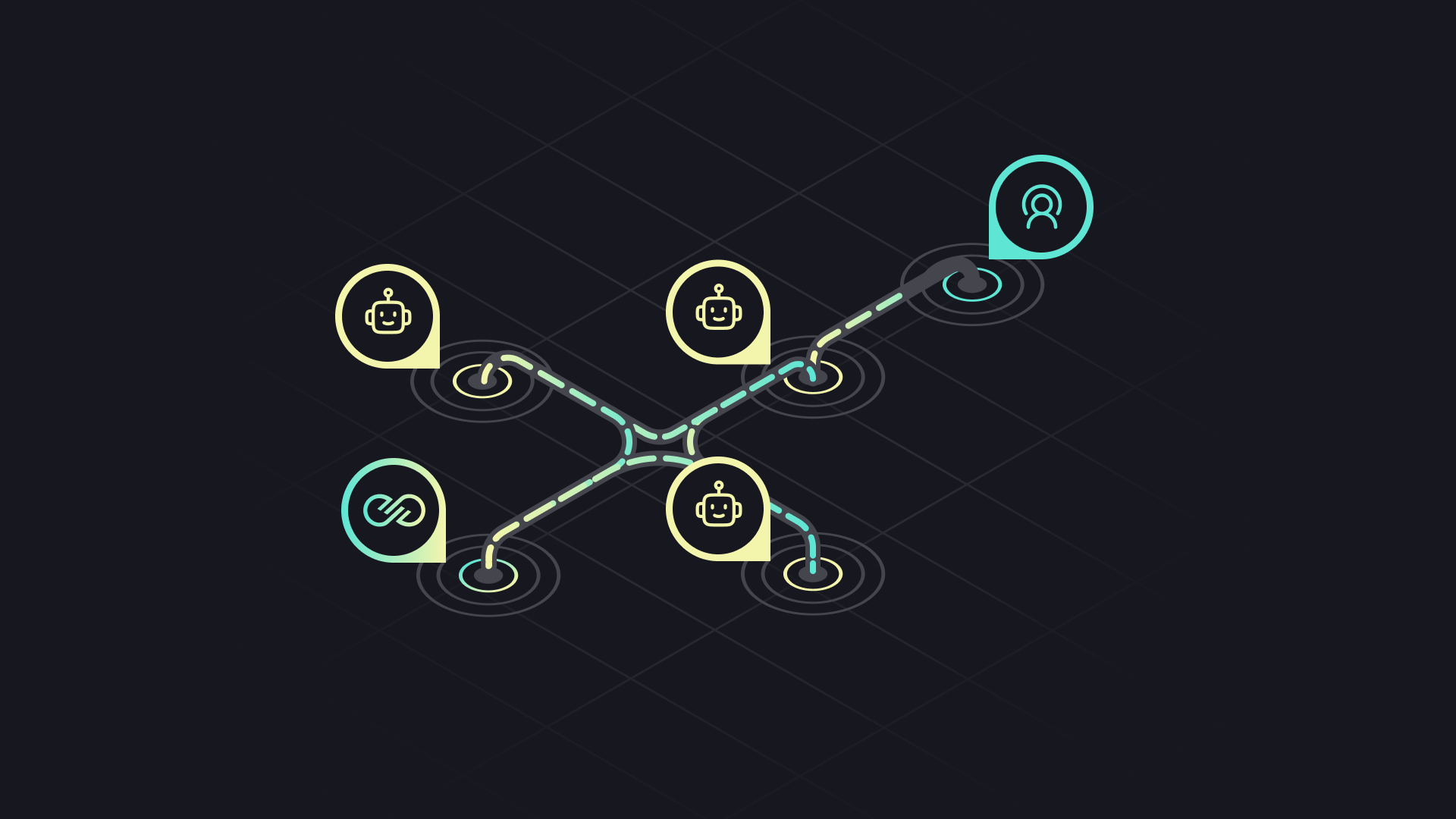
Connective Intelligence links every dataset, system, and decision into a unified data and business context network. In practice, it is embodied as a software layer housed within Equilibrium’s enterprise AI architecture and operating system platform, PowerOS. PowerOS leverages Connective Intelligence to deliver on the promise of accurate, interoperable, intrinsically-linked enterprise AI across the modern power company. Connective Intelligence creates a unified foundation that allows AI agents to understand not just individual data points, but the relationships, dependencies, and business logic that define how power companies actually operate.

Connective Intelligence turns a power company’s data and system siloes into an intrinsically-linked, AI-ready network of data, systems, knowledge, and expertise.

This isn't about AI hype or blindly deploying more siloed AI models. It's about creating the foundation that allows AI to deliver on its promise of enterprise transformation and amplification of human creativity6. Just as the internet required TCP/IP protocols to connect disparate networks, enterprise AI requires a framework to connect disparate enterprise systems into a holistic intelligence network.

Connective Intelligence works in Power because it was purpose-built for Power's specific realities. The Equilibrium Energy team has lived the pain of punishing fragmentation in Power, has built cutting-edge technological innovations in Tech, and has struggled with the gap keeping the latter from helping to solve the former. We were uniquely positioned to solve this gap.

A Technical Introduction: Equilibrium's Enterprise AI Architecture featuring Connective Intelligence

Enterprise AI deployments today often focus on narrow use cases such as semantic search, content generation, or routine document review. While useful, these applications barely scratch the surface of what AI must do to create real enterprise value, especially in high-consequence industries like Power. 

Meaningful impact requires more. Agentic AI-enabled workflows must meet the same standards as the operational workflows they augment: sophistication, flexibility, transparency, and resiliency under pressure7. Analysts increasingly frame the enterprise AI divide as a depth problem: value accrues to organizations that wire AI into core business systems and workflows, not those that stop at isolated pilots8.

Only when a power company’s most important workflows are being successfully augmented by agentic AI can we begin to have confidence in our AI and architectural investments.

Achieving this requires re-architecting workflows to be agentic-AI native. Existing enterprise data, sophisticated techniques, business rules, and expert creativity and intuition must be paired with the immense analytical power of modern AI models. A system with the following characteristics is necessary: AI workflows must be accurate, they must explain their reasoning, they must incorporate dynamic human insights and expertise, and they must run reliably for mission critical operations. This is a new and non-trivial challenge, one made difficult by decades of fragmentation across data, systems, and logic.

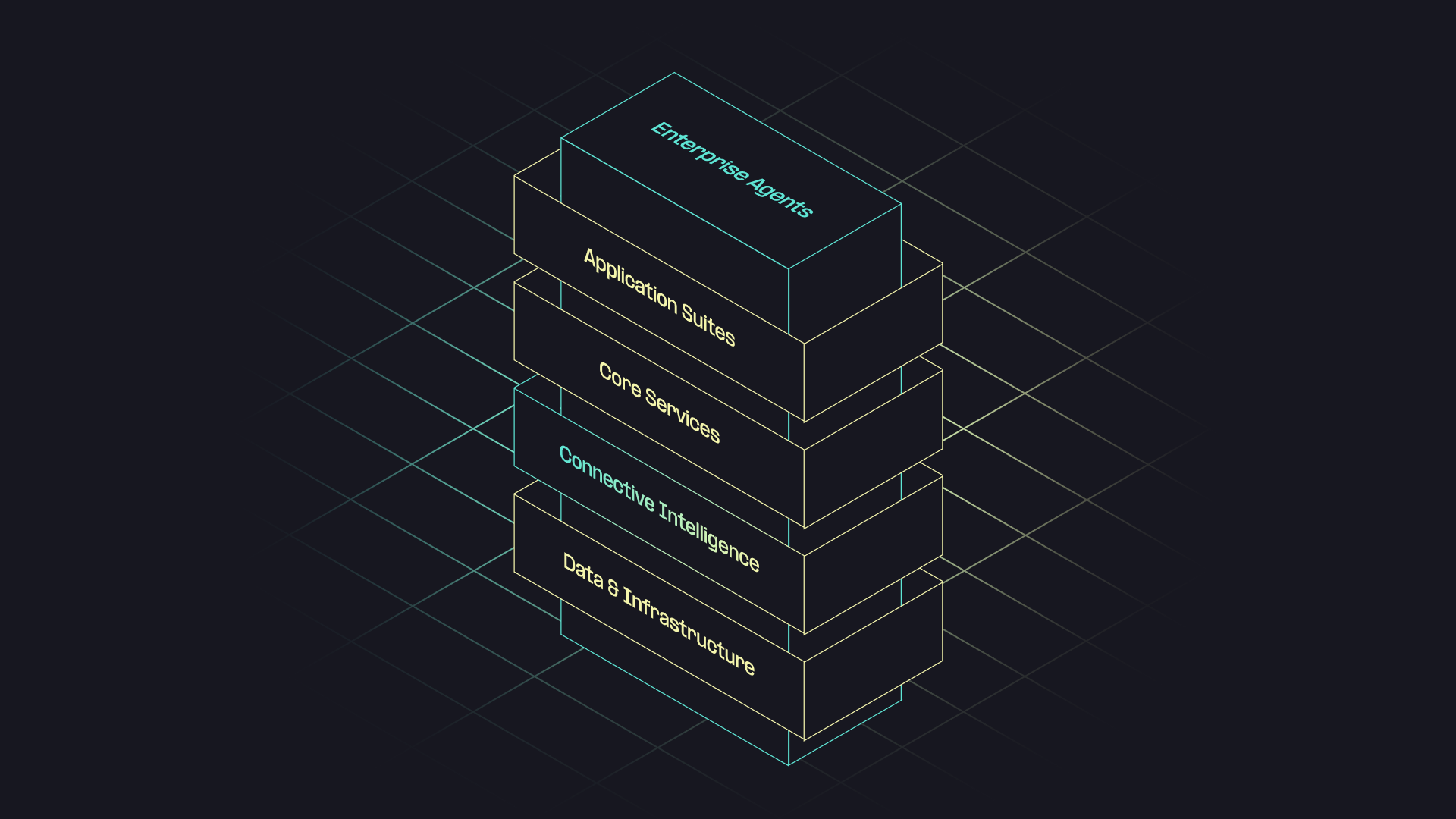
Equilibrium’s Enterprise AI architecture was designed from the ground up to meet this challenge. At its core is Connective Intelligence, the foundational layer that unifies enterprise data structure and business context, enabling the critical trust needed for AI agents to interact across the enterprise and take action at the direction of human experts.

The diagram below introduces Equilibrium’s Enterprise AI Architecture, highlighting the Connective Intelligence layer. Understanding this architecture is essential to grasping how it transforms fragmented systems into a foundation that can unleash AI- plus human-driven innovation, create enterprise value, and ultimately drive lasting business transformation. 

The next sections cover each layer of the technical architecture, starting at the bottom of the stack.

Enterprise Data Layer

The enterprise data layer serves as the source and storage of all things data in Equilibrium’s enterprise AI architecture. Enterprise data consists of third party data, customer data, and proprietary Equilibrium-generated data, and the data platform consists of data pipelines, data storage, data lineage, and knowledge graphs.

The Equilibrium platform integrates data from whatever its source via a growing array of power-specific data pipelines. This data is cleaned, stored, and made available to humans, algorithms, services, applications, and agents via common access patterns, tools, and APIs. End-to-end data lineage allows interrogating what data is utilized in downstream applications, services, algorithms, and agents. This foundational capability is necessary for explainability of algorithms and agents. Finally, knowledge graphs allow dynamic traversal of interconnected data, enabling advanced scientific techniques, models, and applications.

In short: this layer ensures that all enterprise data, regardless of source, can be trusted, traced, and used by both humans and AI.

Connective Intelligence Layer: Enterprise Data Ontology

The Enterprise Data Ontology layer serves as the universal translator and access plane that makes fragmented enterprise data unified, intelligible, and readily accessible across systems. It consists of an ever-growing standardized enterprise data model specific to the power industry, a semantic layer that transforms raw data pipelines into the enterprise data model, and common application schema that support development of interoperable applications, services, and agents across the enterprise.

The fragmented state of data structures within most power companies is a significant source of friction holding back development of cross-use case insights and applications9. Rationalizing the formats of two disparate data sets is a time consuming endeavor requiring many internal experts, and the pure number of data sets needing rationalization is daunting. At its inception and before writing a single line of code, Equilibrium Energy invested in building an end-to-end enterprise data model for power companies to help solve this huge challenge. Our enterprise data model covers key business concepts and data objects across generation, retail, and trading business lines. The data objects within are interconnected, interoperable, and unified. Our power-specific enterprise data model is the foundation for everything that is built on the Equilibrium PowerOS operating system, ensuring that all algorithms, workflows, services, applications, and agents utilize interoperable data.

For power companies, a common data ontology means trading data, asset performance metrics, weather forecasts, and regulatory requirements all speak the same language and can be readily combined. When an expert, application, or AI agent needs to optimize portfolio performance, it can seamlessly access and correlate information from telemetry systems, market platforms, and operational databases without complex and time intensive data transformation processes.

In short: the ontology gives the enterprise a common language so data from different systems can be combined without friction.

Connective Intelligence Layer: Enterprise Code Frameworks

The Enterprise Code Frameworks layer is a growing library of power-specific code frameworks that standardize how code is written and utilized in the PowerOS platform. It consists of 50 and growing code framework libraries relating to power grid fundamentals, power systems science, power market fundamentals, and power systems software

Utilizing a common code framework ensures that applications, algorithms, and services are built in a common fashion and thus are interoperable. Picture two data scientists within a power company building proprietary forecasts. In the absence of a common code framework, each scientist will build their forecasts uniquely. Any application built to use that forecast will unlikely be able to utilize the other. 

Now picture dozens of scientists, researchers, quants, software engineers, data engineers, vendors, and analysts repeating this paradigm across the company. It’s no wonder that power companies suffer from punishing systems fragmentation. Common code frameworks turn this labyrinth into interoperability, and interoperability enables applications, models, and, yes, AI agents to navigate across the entire enterprise.

Interoperable code frameworks have additional benefits for AI agents. They form the foundation for the rules and guardrails that define what an AI agent can and cannot do,  unlocking standard business context and preventing hallucinations. Further, their existence dramatically accelerates the time it takes to design, build, and evaluate a new AI agent, slashing the time it takes to capture business value.

In short: common code frameworks turn fragmentation into interoperability, making it possible to rapidly build applications, models, and AI agents that work across the enterprise.

Agentic and Algorithmic Workflows Layer

Within the Agentic and Algorithmic Workflow Orchestration layer, a collection of algorithms, agents, and services are assembled into business workflows. The layer consists of various workflow orchestrators depending on the workflow type (e.g., data, algorithmic, ML, agentic, services, offline, online, etc.), core services (forecasting, optimization, bidding, etc.), and context retrieval (embedding algorithms, vector storage, retrieval engine). An application or agent can be the collection of one or many of these underlying components.

Utilizing a common orchestration framework enables complex algorithms, services, applications, and agents to be developed in an interoperable fashion. Picture a real-time portfolio optimization strategy workflow helping a trader make decisions amidst a period of electricity market turbulence. Because the workflow is a transparent aggregation of underlying services, algorithms, models, and agent reasoning, the trader can interrogate the inner workings of any specific recommendation to understand if it is suitable for the moment. The trader can also quickly swap components – say, exchange one forecast for another – given the common orchestration framework (and common code frameworks and data formats underneath). Such unified workflow orchestration provides both operational and development flexibility. 

The Equilibrium framework leverages standard semantic search capabilities, but extends these capabilities to power-specific context retrieval. Our proprietary embedding algorithms are designed for the specific nuances of levers of value in Power, and our retrieval and re-ranking algorithms reward the outcomes most important to power industry users.

Algorithmic and agentic evaluations are a multi-faceted approach supported with in-house tooling, from power industry-specific software tests to power systems expert reviews. This integrated approach leads to better generated outputs, more confidence in their application, and ultimately more value to the customer. 

In short: the orchestration layer allows algorithms and AI agents to be assembled, interrogated, and reconfigured into enterprise workflows that are both operationally flexible and explainable to human experts.

User Interfaces

The User Interfaces within PowerOS include applications, services, APIs and SDKs, as well as libraries of agent prompts, tests, and guardrails to ensure agents deliver accurate, explainable responses and actions.

A unified architectural foundation enables blazingly fast application development, applications that span use cases, and applications that leverage services from across the company. Further, Equilibrium builds its applications with human-in-the-loop capabilities to ensure expert oversight, quality assurance, and strategic control remain central to AI operations. Rather than replacing human judgment, Equilibrium’s enterprise AI architecture amplifies it by providing comprehensive context and analysis at enterprise scale.

In short: the user interface layer ensures humans remain firmly in control, giving experts fast, transparent access to insights, actions, and safeguards across the entire enterprise.

What’s Next

A forthcoming companion paper will offer a deeper technical dive, expanding on system architecture, design patterns, and implementation details for engineers and data leaders ready to build on this foundation. In time, we expect to open source large swaths of the Connective Intelligence framework to accelerate the industry’s efforts to reimagine Power for the age of AI.

What is Possible Today

Enterprise AI workflows powered by Connective Intelligence are being utilized today to reimagine how power companies think, plan, act, and compete to win. Our early customers are using them to reconceive their enterprise portfolio management efforts where they plan, assemble, manage, and transact their fleets of energy and financial assets to serve the grid and their customers. The Connective Intelligence layer in PowerOS enables power companies to reliably apply AI to individual assets and use cases for the first time. But the real transformation occurs when AI workflows operate across their entire portfolio (physical assets, financial positions, speculative strategies, dynamic market fluctuations, and risk considerations) as a whole, continuously, together.

Traders are co-optimizing portfolios in real time with holistic visibility across assets, load, hedges, and the market. Operators are dynamically co-optimizing renewables, storage, and conventional generation with precision. Structurers are evaluating new assets and portfolios against their existing portfolios from a co-optimized viewpoint rather than asset-by-asset. Executives are gaining an enterprise-wide view where decisions — strategic, operational, or financial — are informed by the sum of their businesses’ collective insights, rather than isolated swaths of it.

Connective Intelligence is delivering the unified enterprise data and context landscape needed to unleash the amazing and ever-improving frontier AI models to add value to their businesses. Equilibrium’s forward-thinking customers are already demonstrating that enterprise AI can drive an outsized return in Power in months, not years.

Conclusion: Reimagining Power for the Age of AI

Connective Intelligence helps power companies reimagine their operations, strategies, and ultimately what they can become.

The power industry has long been a model of operational precision, data-driven sophistication and expertise, and forward-thinking innovation within a complex and high-consequence environment. Connective Intelligence builds on this history while initiating a new era. An era where the industry’s sophistication, expertise, and foresight is now connected and exponentially amplified by AI.

Power stands at a critical inflection point. Companies that first embrace enterprise AI powered by Connective Intelligence will establish decisive advantages that compound over time. Those that continue with siloed AI approaches will struggle to keep pace. The implications will be far-reaching, as enterprise AI powered by Connective Intelligence will come to redefine how power companies operate. The question is no longer whether this transformation will happen, but which companies will lead it. As IBM’s Gary Cohn warns, “At this point, leaders who aren't leveraging AI and their own data to move forward are making a conscious business decision not to compete.”10

Visit equilibriumenergy.com or follow us on LinkedIn to learn more about how AI is shaping the future of Power.

An Invitation to Innovators: While born in Power, the Connective Intelligence principles — unification of data structures and business context to unlock enterprise AI systems in high consequence situations — apply wherever complexity meets consequence. As industries face mounting challenges, from navigating uncertainty to advancing innovation, we believe there is value in sharing our approach and rubric more widely. Equilibrium invites innovators from other sectors to borrow and build on the Connective Intelligence framework and advance responsible, context-driven AI transformation across every complex and societally-consequential industry.

© 2025 Equilibrium Energy. Connective Intelligence™ is a trademark of Equilibrium Energy.

1. MIT Center for Information Systems Research. 2025 Enterprise AI Maturity Update. Woerner, S., Sebastian, I., Weill, P., and Kaganer, E., MIT Sloan School of Management, 2025. https://cisr.mit.edu/publication/2025_0801_EnterpriseAIMaturityUpdate_WoernerSebastianWeillKaganer
2. Theory Ventures.
The Business Context Layer: The Missing Ingredient for Enterprise AI. Theory Ventures, 2024. https://theoryvc.com/blog-posts/business-context-layer
3. IBM.
IBM Addresses the AI Adoption Gap with “Let’s Create Smarter Business.” IBM Newsroom, September 3, 2025. https://newsroom.ibm.com/2025-09-03-IBM-Addresses-the-AI-Adoption-Gap-with-Lets-create-smarter-business
4. WorkOS.
Why Most Enterprise AI Projects Fail: Patterns That Work. WorkOS, 2024. https://workos.com/blog/why-most-enterprise-ai-projects-fail-patterns-that-work
5. World Economic Forum.
Closing the Intelligence Gap: How Leaders Can Scale AI with Strategy, Data, and Workforce Readiness. WEF, 2025.https://www.weforum.org/stories/2025/10/closing-the-intelligence-gap-how-leaders-can-scale-ai-with-strategy-data-and-workforce-readiness/
6. McKinsey & Company.
Digital Transformation in Energy: Achieving Escape Velocity. McKinsey, 2024. https://www.mckinsey.com/industries/oil-and-gas/our-insights/digital-transformation-in-energy-achieving-escape-velocity
7. Boston Consulting Group.
AI Adoption in Energy: From Pilots to Performance. BCG, 2024. https://www.bcg.com/publications/2024/ai-adoption-in-energy
8. WorkOS.
Why Most Enterprise AI Projects Fail: Patterns That Work. WorkOS, 2024. https://workos.com/blog/why-most-enterprise-ai-projects-fail-patterns-that-work
9. Cegal.
The Flood of Data in the Power Industry: Why Better Data Management Brings Big Gains. Cegal, 2024. https://www.cegal.com/en/resources/flood-of-data-in-the-power-industry-better-data-management-can-bring-big-gains
10. IBM.
IBM Addresses the AI Adoption Gap with “Let’s Create Smarter Business.” IBM Newsroom, September 3, 2025. https://newsroom.ibm.com/2025-09-03-IBM-Addresses-the-AI-Adoption-Gap-with-Lets-create-smarter-business

Connective Intelligence™: The Missing Layer to Unlock Enterprise AI in Power
News & Updates
Connective Intelligence™: The Missing Layer to Unlock Enterprise AI in Power
Introducing Equilibrium’s PowerOS:  The Agentic AI Platform for Power
News & Updates
Introducing Equilibrium’s PowerOS: The Agentic AI Platform for Power
Canary Media: Building the power company of the future
News & Updates
Canary Media: Building the power company of the future
Get in touch.

Want to see our platform in action?

Contact Us
Battery
90.25
MWh
Battery charge graphBattery charge graph
Texas Battery I